Types of Shih Tzu: Imperial, American, European, Colors and Cuts Explained
Part of our guide: Shih Tzu breed profile
Quick answer: There is only one type of Shih Tzu. The AKC, the Canadian Kennel Club and other registries recognize a single breed with one standard each. Imperial, teacup, American, European and the many 'types with pictures' found online are marketing names, show styles, coat colors, haircuts or mixed breeds, not separate kinds of Shih Tzu.
On this page
How we researched this article: This guide is based on the American Kennel Club (AKC) and Canadian Kennel Club (CKC) breed standards, the American Shih Tzu Club’s statement on “imperial” dogs, and the breed’s documented history. Every source is listed at the end. Last reviewed: November 2026.
Search for types of Shih Tzu and you will find lists of 5, 10 or even 14 “types”: Imperial, teacup, American, European, Chinese, plus a rainbow of colors and mixes. It looks like a big family. It isn’t. The Shih Tzu is one breed. Every name on those lists is really a size label, a show style, a coat color, a haircut or a different breed altogether. Here is what each one means, and what to watch for when a seller uses it.
One Breed, One Standard per Kennel Club
A breed standard is the written description of the ideal dog. Each national kennel club keeps its own, and each has only one standard for the Shih Tzu:
| American Kennel Club (US) | Canadian Kennel Club | |
|---|---|---|
| Group | Toy Group (since 1969) | Non-Sporting Group (Group VI) |
| Height | Ideally 9 to 10½ inches; not under 8 or over 11 | About 9 to 10½ inches (22.75 to 26.75 cm) |
| Weight | 9 to 16 pounds | No weight given |
| Color | All colors permissible | All colors, with black nose, lips and eye rims (livers and blues have matching pigment) |
| Separate types or sizes? | None | None |
Internationally, the Fédération Cynologique Internationale (FCI) places the Shih Tzu with the Tibetan breeds in its Companion and Toy Dog Group. The UK’s Royal Kennel Club lists it in the Utility group. The group a dog is shown in is an administrative choice. It does not make the dog a different type.
For the full picture of size, coat and personality, see our Shih Tzu breed profile.
Imperial, Teacup and Miniature Shih Tzus
These names all mean the same thing: a Shih Tzu sold as smaller than the standard. The American Shih Tzu Club calls “imperial” and “tiny teacup” a myth, often used by unethical breeders to sell dogs that do not meet the standard. There is no AKC-recognized Imperial or teacup Shih Tzu, and the club says there is no proof an “imperial gene” exists.
Very small dogs come from the odd runt in a litter, or from breeding the smallest dogs together again and again, which the club warns can produce puppies with health problems. Tiny puppies are also more prone to low blood sugar. Read the full story in our guide to the mini Shih Tzu.

American vs European Shih Tzu
You will often read that the American Shih Tzu is taller with a shorter coat, while the European Shih Tzu is stockier and closer to the “original” dog. We could not find any kennel club, breed club or study that defines these as types, or any measurements that back up those claims.
What is true is simpler:
- The breed reached the West through Europe. The first dogs came from China to England in 1928, and the first European standard was written in England in 1935. According to the AKC, today’s Shih Tzus, American ones included, descend from dogs imported into England and Scandinavia between 1928 and 1952. Our Shih Tzu history has the details.
- Each country writes its own standard. The AKC, the CKC, the Royal Kennel Club and the FCI describe the same breed with slightly different wording, group placement and size figures. Show breeders in each country select toward their own standard, so winning show dogs can look a little different from place to place.
- Coat length is grooming, not type. Every Shih Tzu has a long double coat if left to grow. A short coat means a haircut, such as a puppy cut, not a different kind of dog.
So an “American” or “European” Shih Tzu is simply a Shih Tzu bred in that region, usually from show lines. If a seller charges more for a “European” puppy, ask to see the parents’ registration papers and health tests, just as you would for any puppy.
Color “Types”
Many “types of Shih Tzu” lists are really lists of coat colors: black, white, gold, liver, brindle, black and white, and so on. The AKC standard says all colors are permissible, so these are all the same breed. Color does not change a Shih Tzu’s size or personality.
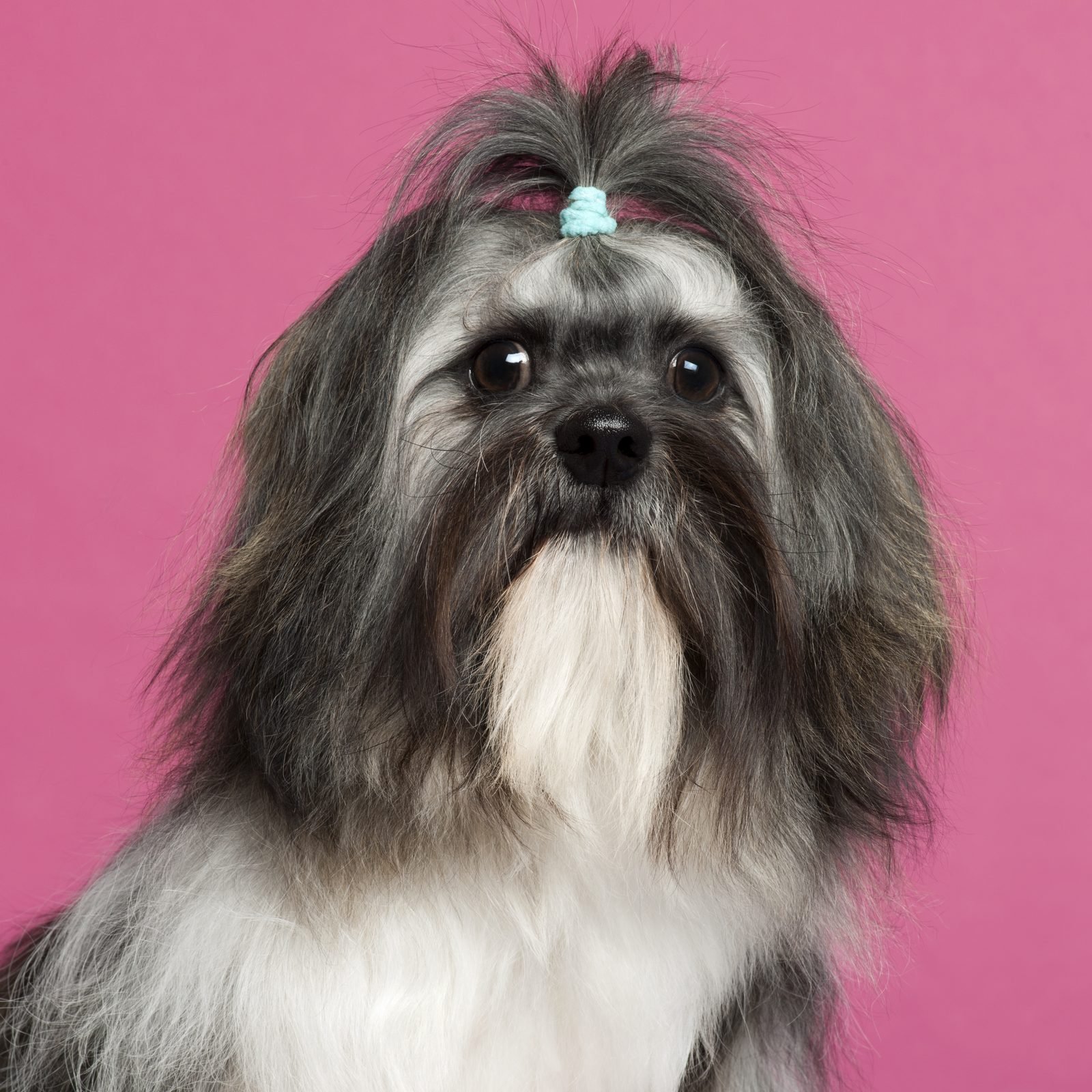
A black Shih Tzu is the same breed as a gold or white one. Only the coat color differs.
Be careful with puppies sold at a premium as a rare color. Merle, for example, is not a traditional Shih Tzu pattern, and dogs with two copies of the merle gene have a higher risk of deafness and eye defects. See our guide to rare Shih Tzu colors for what is normal and what is a warning sign.
Haircut “Types”
Some photos labelled as Shih Tzu types simply show different grooming styles. The same dog can wear a long show coat one year and a short cut the next:
- Long coat: the full, floor-length coat with a topknot, as in the show ring.
- Puppy cut: the whole coat trimmed short and even.
- Teddy bear cut: a short body with a rounder, fuller face. See our teddy bear cut guide.
More styles are in our guide to Shih Tzu haircuts.
Mixes Are Not Shih Tzu Types
Shih Poos, Shichons, Malshis, Shorkies and other crosses are often listed as Shih Tzu types. They are mixed-breed dogs, half Shih Tzu and half another breed, so their size, coat and temperament can vary a lot even within one litter. They cannot be registered as Shih Tzus with the AKC or the CKC.
The Lhasa Apso is also sometimes called a type of Shih Tzu. It is a separate breed: bigger, longer-nosed and warier of strangers. See Lhasa Apso vs Shih Tzu for how to tell them apart, and our list of Shih Tzu mixes for the popular crosses.
How to Check What You Are Buying
If a seller uses a “type” name to justify a high price, these questions help:
- Is the puppy registered, and with which club? Ask for the registration of both parents.
- What do the parents weigh? Adult Shih Tzus that fit the AKC standard weigh 9 to 16 pounds. A promise that a puppy will stay far smaller is a red flag.
- What health checks were done on the parents, and does the puppy come with vet records?
- Can you meet the mother and see where the puppies are raised?
Our guide on how to spot a full breed Shih Tzu goes through papers, looks and red flags in more detail. For typical prices, see how much a Shih Tzu costs.
Frequently asked questions
How many types of Shih Tzu are there?
One. The Shih Tzu is a single breed, and no kennel club recognizes separate types or sizes. Names like Imperial, teacup, American and European describe size, show style or marketing, not different breeds.
What is the difference between an American and a European Shih Tzu?
Both are the same breed. Each national kennel club writes its own standard, so show dogs bred in different countries can differ a little in look. No kennel club registers an 'American' or 'European' Shih Tzu as a separate type.
Is an Imperial Shih Tzu a real type?
No. The American Shih Tzu Club calls 'imperial' and 'tiny teacup' a myth used to sell dogs that are smaller than the breed standard. The AKC recognizes no Imperial or teacup Shih Tzu.
Are Shih Tzu colors different types?
No. The AKC standard says all colors are permissible. A black, white, gold or brindle Shih Tzu is the same breed, and color does not change size or temperament.
Is a Shih Poo or Shichon a type of Shih Tzu?
No. They are crosses between a Shih Tzu and another breed (a Poodle or a Bichon Frise). Mixed-breed dogs cannot be registered as Shih Tzus with the AKC or the Canadian Kennel Club.
Sources
- American Kennel Club. Official Standard of the Shih Tzu.
- Canadian Kennel Club. Shih Tzu breed standard, 2026.
- American Shih Tzu Club. The Facts About “Imperial” Shih Tzu and “Designer Dogs”.
- American Kennel Club. Lhasa Apso vs. Shih Tzu: Similarities and Differences.
- American Kennel Club. Shih Tzu History: Where the Breed Originated.
- Wikipedia. Shih Tzu (the 1935 English standard, FCI group and AKC recognition in 1969, with their original references).
- The Royal Kennel Club. Shih Tzu breed standard (Utility group).