Shih Tzu Tear Stains: Causes, Safe Cleaning, and When It’s an Eye Problem
How we researched this article: This guide is based on a 2023 Veterinary Ophthalmology study of 50 Shih Tzus, a 2026 review of brachycephalic ocular syndrome in Today’s Veterinary Practice, VCA Animal Hospitals, MedVet’s veterinary ophthalmology team, and the FDA’s 2014 warning letters on tear-stain products. Every source is listed at the end. Last reviewed: October 2026.
Go to an emergency vet now if: your Shih Tzu’s eye looks cloudy, bluish, or bulging. See a vet the same day if: your dog is squinting, pawing at its eye, or holding an eye half-closed. A brown stain alone is not an emergency, but these signs can mean a corneal injury.
Most Shih Tzu tear stains are a cosmetic problem caused by the breed’s face shape, not by disease. Tears spill onto the fur instead of draining into the nose, and an iron-containing pigment in those tears turns the hair rust-brown. The fix is daily cleaning, short hair around the eyes, and a vet check to rule out an eye problem. No product makes them vanish for good.
That last point matters, because tear stains are one of the most over-sold problems in dog care. Below is what the veterinary evidence actually supports, what to skip, and the warning signs that mean the stain is not just a stain.
Quick answer: how do I get rid of my Shih Tzu’s tear stains?
- Get one vet eye exam first, to rule out ingrown hairs, eyelid problems, or a blocked tear duct.
- Wipe the area once or twice a day with a soft cloth and plain water or a vet-approved eye wipe, then dry it.
- Keep the hair at the inner corners of the eyes trimmed short, or tied up in a top knot.
- Expect old stained hair to grow out over weeks to months; new hair will grow in cleaner.
- Never use hydrogen peroxide near the eyes, and skip any product that contains an antibiotic.
What tear stains actually are
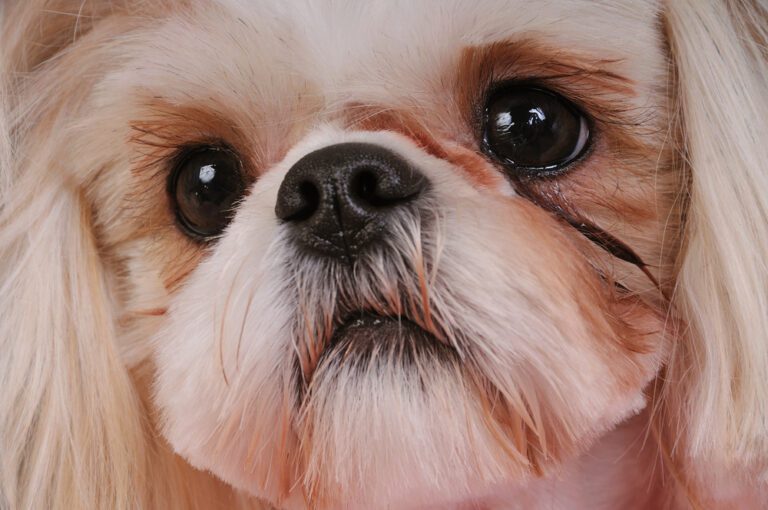
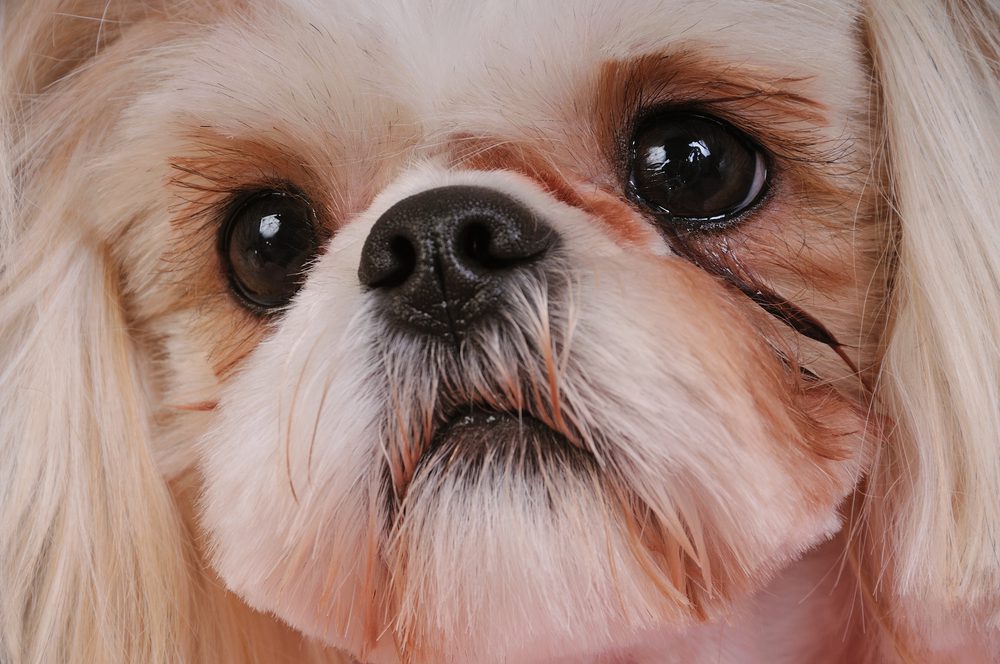
The color comes from porphyrins, iron-containing molecules left over when the body breaks down red blood cells. Dogs pass porphyrins out in tears, saliva, urine and stool, so every dog has some in its tears (MedVet, ophthalmologist-reviewed). On a black or gold Shih Tzu you rarely notice it. On white or cream hair, the pigment shows as a rust or reddish-brown streak running down from the inner corner of each eye.
That same pigment explains two things owners often ask about:
- Stains around the mouth or paws. Saliva carries porphyrins too, so a dog that licks its paws or has a wet beard can stain there as well.
- Brown, smelly, or damp stains. Hair that stays wet against the skin can lead to odor, skin irritation and skin infection (VCA Animal Hospitals). A stain that smells, feels greasy, or has red skin underneath needs a vet, not a stronger wipe.
The medical name for tears overflowing onto the face is epiphora. It is a symptom, not a diagnosis: it can come from making too many tears, from tears not draining properly, or both.
Why Shih Tzus get tear stains so often
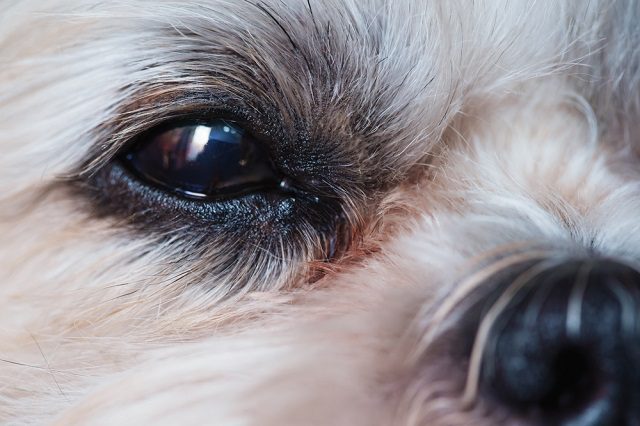
Shih Tzus are built for tear stains. A 2023 study in Veterinary Ophthalmology examined 50 Shih Tzus and found hair from the inner eye corner touching the eye (caruncular trichiasis) and an inward-rolled inner lower eyelid (medial entropion) in every eye examined. In 82% of eyes the lids did not close fully during blinks (Sebbag et al., 2023). Veterinary ophthalmologists group these traits under brachycephalic ocular syndrome. A 2026 review by a board-certified veterinary ophthalmologist names Shih Tzus among the breeds most often and most severely affected by misplaced eyelashes, and explains that the inward-rolled inner eyelid can block the tear drainage opening (Today’s Veterinary Practice).
In plain terms, five things push tears onto the face:
| Cause | What happens | Fixable? |
|---|---|---|
| Flat face and shallow eye sockets | Tears roll off the lid edge before reaching the drainage hole | Managed, not cured |
| Inner-corner eyelid rolling inward | The lid wicks tears onto the fur and rubs the eye | Sometimes, with surgery |
| Hair at the inner corner | Hair touches the eye, irritates it, and soaks up tears like a wick | Yes, with trimming |
| Extra or misplaced eyelashes (distichiasis) | Lashes rub the eye surface and trigger more tearing | Yes, by a vet |
| Blocked or narrow tear duct | Tears cannot drain into the nose | Often, by flushing under anesthesia |
Other triggers make it worse: allergies, eye infections, dental disease and ear infections are all listed as contributors by MedVet’s ophthalmology team. Teething puppies also tear more, which is why stains often appear at 3 to 6 months and fade once adult teeth are in.
One reassuring point: most dogs with tear stains make normal amounts of tears and have no eye disease. The usual cause is simply eyelid shape letting tears spill instead of drain (MedVet). The goal of the vet visit is to confirm your dog is in that majority.
Cosmetic stain or eye problem?
Look at the eye, not just the fur. A comfortable, bright, open eye with clear tears and a brown streak below it is the cosmetic pattern. Anything else in the table below needs a vet, and the last row needs one today.
| What you see | Likely meaning | What to do |
|---|---|---|
| Clear tears, rust stain, eye looks normal, dog not bothered | Cosmetic tear staining from face shape | Home care below; mention it at the next checkup |
| Stain appeared suddenly, or only one eye | New irritation, injury, or a blocked duct on that side | Vet visit within a few days |
| Thick yellow, green, or gray discharge | Possible infection | Vet visit within 1 to 2 days |
| Red, raw, or smelly skin under the stain | Skin infection from constant moisture | Vet visit; don’t keep scrubbing |
| Squinting, pawing at the eye, eye held half-closed | Pain, often a corneal scratch or ulcer | Same day |
| Cloudy or bluish patch on the eye, or eye looks bulging | Corneal ulcer, glaucoma, or the eye shifting out of its socket | Emergency vet now |
Shih Tzus’ prominent eyes make corneal injuries a real risk, so do not wait out squinting. Our Shih Tzu eye problems guide covers each of these conditions in detail.
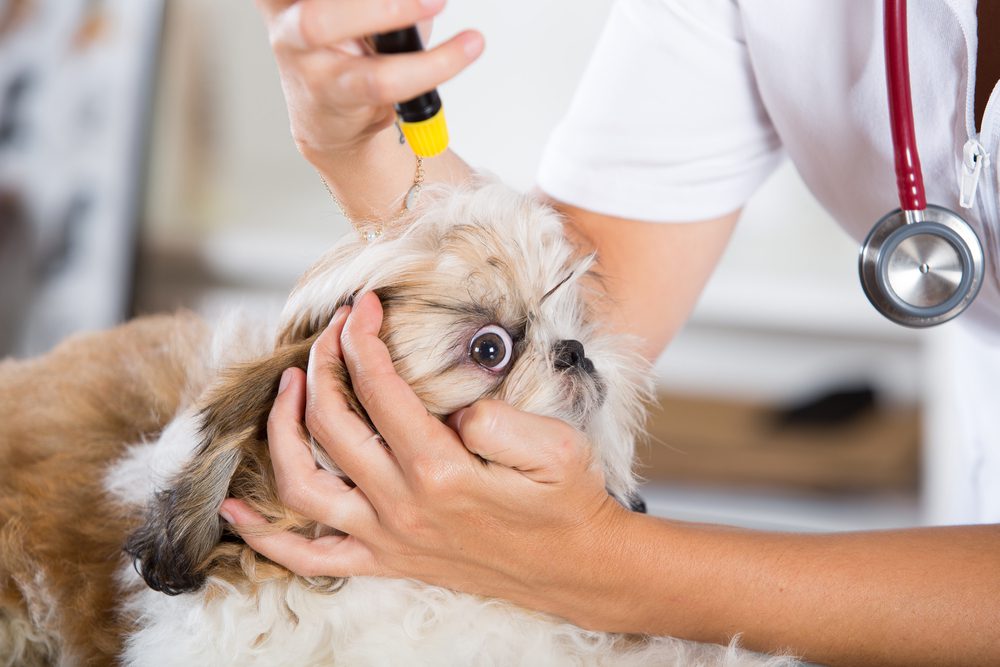
At the exam, the vet may run a Schirmer tear test, a fluorescein stain (which shows scratches and, if it reaches the nostril, confirms the tear duct is open), and check for stray lashes and eyelid rolling (VCA; MedVet). If a duct is blocked, it can often be flushed under anesthesia.
How to clean Shih Tzu tear stains safely
The aim is a face that stays clean and dry, every day. Veterinary sources agree that keeping the area clean and dry, removing build-up, and trimming the hair short around the eyes is what helps (VCA). This routine takes about two minutes.
You need: soft cotton pads or a clean washcloth, lukewarm water (or a vet-approved eye-area wipe), a fine-toothed comb, and a dry towel.
- Check the eye first. If it is red, squinting, or has thick discharge, stop and see the table above.
- Soften the crust. Hold a pad dampened with lukewarm water against the inner corner for 10 to 15 seconds. Dried tear crust lifts off without pulling hair.
- Wipe away from the eye. Wipe from the inner corner down and outward along the stain. Use a fresh pad for the second eye so you don’t carry bacteria across.
- Comb out debris. Gently run a fine comb under the eye, pointing away from it, to lift anything left in the hair.
- Dry thoroughly. Pat the hair dry. Moisture left sitting is what feeds odor and skin infection.
- Repeat once or twice a day, and after meals if your dog has a wet beard.
For a weekly deeper clean, MedVet’s ophthalmology team suggests gently washing the face with a warm washcloth and a mild baby shampoo, kept well away from the eyes, then drying completely (MedVet).
About the stain already there: stained hair rarely goes fully white again. The realistic goal is to stop new staining, then let the old hair grow out or be trimmed away by a groomer. Most owners see a clear difference within a few weeks to two months of consistent care.
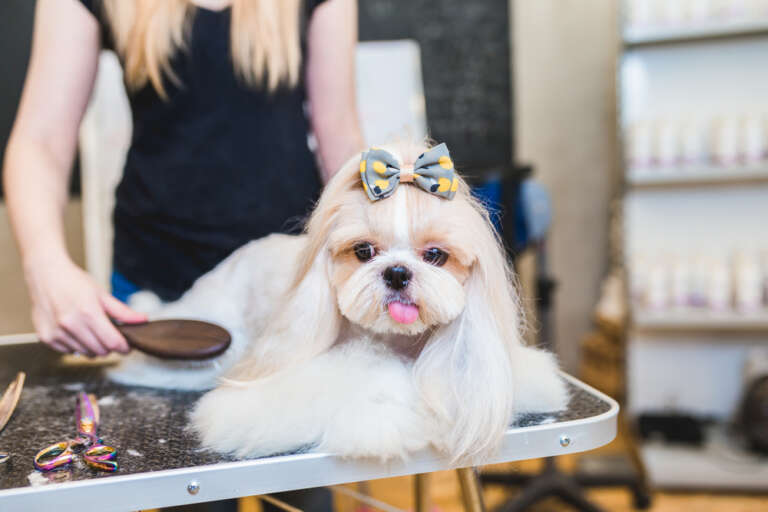
Working on the whole face routine? Our Shih Tzu grooming guide covers face trimming and the tools, and our brush and comb picks include the fine combs that work for eye areas.
What not to put near your Shih Tzu’s eyes
A lot of tear-stain advice still circulating online is outdated or risky. A Shih Tzu’s eyes sit forward and exposed, so a splash that a long-nosed breed would shrug off can scratch or burn a Shih Tzu’s cornea.
| Skip this | Why |
|---|---|
| Hydrogen peroxide, or pastes made with it | VCA warns it can cause severe eye damage if it splashes into the eye (VCA). |
| Tear-stain powders or chews containing an antibiotic (tylosin) | In 2014 the FDA sent warning letters to the makers of Angels’ Eyes, Angels’ Glow, Pets’ Spark, Glow Groom and Health Glow, because tylosin is not approved for dogs or for tear staining (dvm360). Vets also advise against low-dose antibiotics for staining because of antibiotic resistance (VCA). |
| Contact lens solution | A board-certified veterinary ophthalmologist at MedVet advises against using it near the eye, because it can irritate (MedVet). |
| Lemon juice, vinegar, or homemade bleaching mixes | Acidic and untested; a drip into the eye stings and can damage the surface. |
| Loose boric acid or cornstarch powders | Powder easily ends up in the eye. Use only a product your vet names. |
| Human makeup remover or scented wipes | Fragrance and alcohol can irritate both eyes and skin. |
If a product claims to “eliminate tear stains from the inside out,” check the ingredient list for tylosin before buying, and ask your vet before using any supplement. Antibiotics have a real place for tear stains only when a vet diagnoses a skin infection, and then as a short, properly dosed course.
How to prevent tear stains from coming back
Prevention is mostly hair management and dryness. These are listed in order of how much difference they usually make.
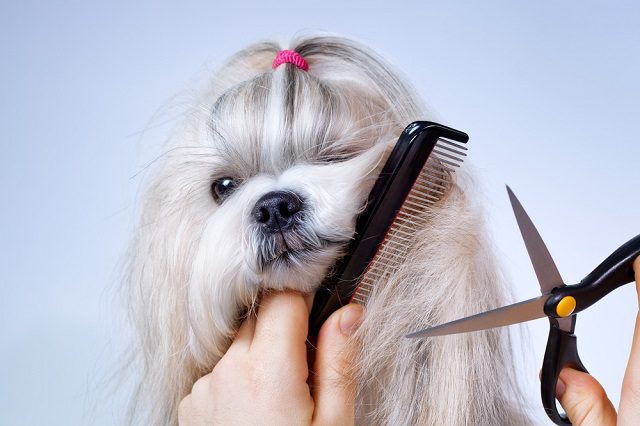
- Keep the inner-corner hair short. Hair at the inner corner touches the eye and wicks tears onto the face. Ask your groomer to trim it close at every visit, or trim it yourself with round-tipped scissors held parallel to the face, never pointing at the eye. If you can’t hold your dog still, leave this to the groomer.
- Tie the head hair up. If you keep a longer coat, a small top knot pulls hair off the eyes. Use a soft latex or fabric band, not a tight elastic, and redo it every day or two.
- Dry the beard after meals and drinks. A wet beard stains too, and a damp chin keeps the whole lower face moist. A quick pat with a towel after the water bowl helps.
- Treat allergies if they’re present. Seasonal or food allergies raise tear production. If your Shih Tzu also scratches, licks its paws, or has ear trouble, read our guide to Shih Tzu itchy skin and allergies and talk to your vet about an elimination diet.
- Keep up dental and ear care. MedVet’s ophthalmology team lists dental disease and ear infections among the contributors to tear staining (MedVet). See our guides to Shih Tzu teeth care and ear care.
- Book a yearly eye check. Given how common eyelid and lash problems are in this breed, ask your vet to look at the eyes at every annual visit, not only when something seems wrong.
What about diet and water? MedVet suggests a complete, balanced diet without artificial colorants, and notes that limited-ingredient diets and omega-3 fatty acids may help some dogs (MedVet). Hard tap water is often blamed online, but there is little evidence for it. You don’t need to switch your dog to distilled water. If you want to change food, our picks for dogs with allergies are a reasonable starting point; change foods gradually over 7 to 10 days.
Do tear stain removers and supplements work?
Some help a little; none is a cure. VCA’s veterinary authors note that no remedy has proven 100% effective, that over-the-counter products have not been shown to work in research trials, and that some may harm the eyes (VCA). Here is where the evidence stands for each type.
| Type | Evidence | Our take |
|---|---|---|
| Eye-area wipes and gentle cleansers | Help with daily removal of tear residue; they don’t change tear flow | Useful for convenience; plain water works too |
| Topical stain lighteners | MedVet notes some boric-acid removers can lighten existing stains | Only with your vet’s OK, and never in the eye itself |
| Probiotics | VCA cites some evidence of benefit, but it can take a couple of months to show | Reasonable to try with your vet’s input |
| Omega-3 and antioxidant supplements | MedVet suggests they may improve tear quality | Low risk; ask your vet about dose |
| Antibiotic-based powders and chews | Not approved for dogs; FDA warning letters in 2014 | Avoid |
If you do buy a remover, check that it: contains no antibiotic (tylosin), no hydrogen peroxide and no fragrance; is labeled as safe for use around the eyes; and is one your vet is comfortable with. Give any product four to eight weeks of daily use before judging it, because only new hair growth shows the result.
Shih Tzu tear stain FAQs
Are tear stains painful for my Shih Tzu?
The stain itself isn’t painful. Pain comes from what may be causing it, such as hair or lashes rubbing the eye, or from irritated wet skin. Squinting or pawing at the eye means a vet visit.
Will my Shih Tzu puppy grow out of tear stains?
Often partly. Teething puppies tear more, and stains frequently ease once adult teeth are in. Face shape doesn’t change, though, so many Shih Tzus need daily wiping for life.
How long does it take for tear stains to go away?
New staining can stop within days of good daily care. Existing stained hair has to grow out or be trimmed, which usually takes several weeks to two months.
Why are my Shih Tzu’s tear stains getting worse?
Common reasons are longer hair at the eye corners, allergy season, a new eye irritation, or dental or ear problems. A sudden change, especially in one eye, is worth a vet check.
Do black Shih Tzus get tear stains?
Yes, they produce the same pigment, but it doesn’t show on dark hair. Their eyes still need the same daily check and wiping.
Can surgery fix tear stains?
Sometimes. If the cause is an inward-rolling inner eyelid or misplaced lashes, a veterinary ophthalmologist may recommend surgery, such as a procedure to reshape the inner eye corner. Researchers studying Shih Tzu eyes have suggested this procedure as a preventive option for the breed. (Sebbag et al., 2023)
Is it safe to use tear stain wipes every day?
Unscented wipes labeled for the eye area are generally fine daily. Stop if the skin turns red or your dog starts squinting.
Sources
- Sebbag L, Silva APSM, Santos ÁPB, Raposo ACS, Oriá AP. An eye on the Shih Tzu dog: Ophthalmic examination findings and ocular surface diagnostics. Veterinary Ophthalmology. 2023;26(S1):59-71.
- Plummer CE, DVM, DACVO. Understanding and Addressing Brachycephalic Ocular Syndrome. Today’s Veterinary Practice, April 2026.
- Barnes C, Llera R, Ward E. Eye Discharge (Epiphora) in Dogs. VCA Animal Hospitals.
- MedVet, reviewed by Vanessa J. Kuonen Cavens, DVM, MS, DACVO. Everything You Need to Know About Tear Staining in Dogs. January 2026.
- dvm360. FDA warns makers of tear stain removers to pull products from market. September 19, 2014.
This article is for general information. It is not a substitute for advice from your veterinarian. Read our medical disclaimer.