Shih Tzu Grooming Guide: Step-by-Step Routine and the Best Tools (2026)
Disclosure: This guide contains affiliate links. As an Amazon Associate, Shih Tzu Pedia earns from qualifying purchases, at no extra cost to you. We choose products based on published guidance from breed and veterinary groups, product specifications, and suitability for small, long-coated dogs. We have not received free products from any brand.
How we researched this article: This guide draws on grooming advice from the American Shih Tzu Club and the American Kennel Club, nail and handling guidance from VCA Animal Hospitals, the Veterinary Oral Health Council list of accepted dental products, and a 2024 Royal Veterinary College study of more than 11,000 Shih Tzus. Every source is listed at the end. Last reviewed: September 2026.
A Shih Tzu’s coat grows long and silky, and it tangles fast. Regular grooming keeps your dog comfortable, clean, and healthy. It also lets you spot skin, eye, and tooth problems early.
This guide walks you through a full home grooming routine: brushing, bathing, face and eye care, paws, nails, and teeth. It also lists the tools that make each job easier and safer. It replaces our earlier separate articles on grooming, face trimming, paw pad trimming, and nail trimming.
Quick Picks: The Shih Tzu Home Grooming Kit
You do not need a professional salon setup. These tools cover almost every home grooming task for a Shih Tzu.
| Tool | What it is for | Our pick | |
|---|---|---|---|
| Pin brush | Daily brushing of a long coat | Chris Christensen 27 mm Oval Pin Brush | Check price on Amazon |
| Steel comb | Finding tangles the brush missed | Chris Christensen Greyhound-Style Buttercomb (fine/coarse) | Check price on Amazon |
| Detangling spray | Easier brushing and fewer broken hairs | TropiClean Detangler Spray | Check price on Amazon |
| Round-tip scissors | Trimming around the face and feet | GLADOG 5-in-1 Grooming Scissors Set with Safety Round Tips | Check price on Amazon |
| Mini trimmer | Clearing hair between paw pads | oneisall Low-Noise Paw Trimmer | Check price on Amazon |
| Nail clippers | Monthly nail trims | gonicc Nail Clippers for Small and Medium Dogs | Check price on Amazon |
| Nail grinder | Smoothing nails, or for dogs that dislike clippers | Casfuy 2-Speed Nail Grinder | Check price on Amazon |
| Styptic powder | Stopping bleeding if you nick a nail | Miracle Care Kwik Stop | Check price on Amazon |
| Dog toothpaste | Daily tooth brushing | Petsmile Professional Toothpaste (VOHC accepted) | Check price on Amazon |
| Dog toothbrush | Reaching small teeth | Soft-Bristle Pet Toothbrush | Check price on Amazon |
| Topknot bands | Keeping hair out of the eyes | PET SHOW Latex Grooming Bands | Check price on Amazon |
| Paw balm | Protecting pads from salt, heat, and dry weather | Musher’s Secret Paw Wax | Check price on Amazon |
Looking for more choices? See our full guides to the best brushes for Shih Tzus, the best shampoos for Shih Tzus, and the best dog clippers for Shih Tzus.
How Often Should You Groom a Shih Tzu?
Here is a simple schedule based on advice from the American Shih Tzu Club, the American Kennel Club, and VCA Animal Hospitals. Adjust it for your dog’s coat length and lifestyle.
| Task | How often |
|---|---|
| Brush and comb the coat | Daily for a long coat. Several times a week for a short puppy cut. |
| Comb the face, mustache, and topknot | Daily |
| Wipe the eye corners | Daily |
| Brush the teeth | Daily is best |
| Bath | About every 3 to 4 weeks, or when dirty |
| Trim nails | About once a month |
| Trim hair between paw pads | Every 2 to 4 weeks, or when it covers the pads |
| Professional groom (puppy cut) | Every 4 to 6 weeks |
Start young and keep it positive. Short, calm sessions with treats teach puppies that grooming is normal. VCA Animal Hospitals recommends handling exercises, such as gently touching paws and lifting lips, before you ever pick up clippers or a toothbrush. Our Shih Tzu puppy care guide has more tips for the first months.
Step 1: Brushing and Combing
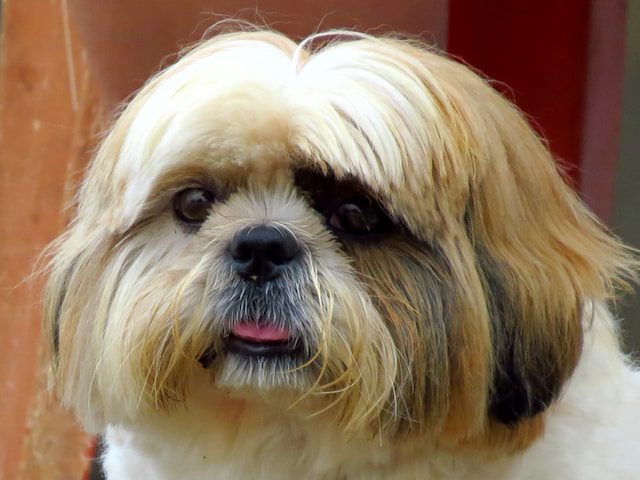
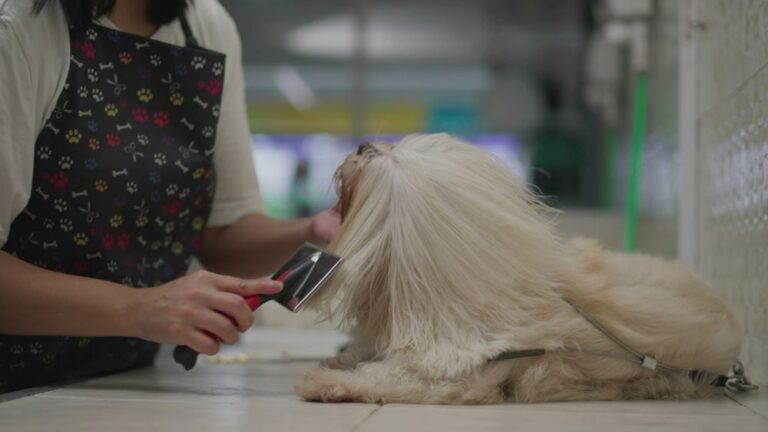
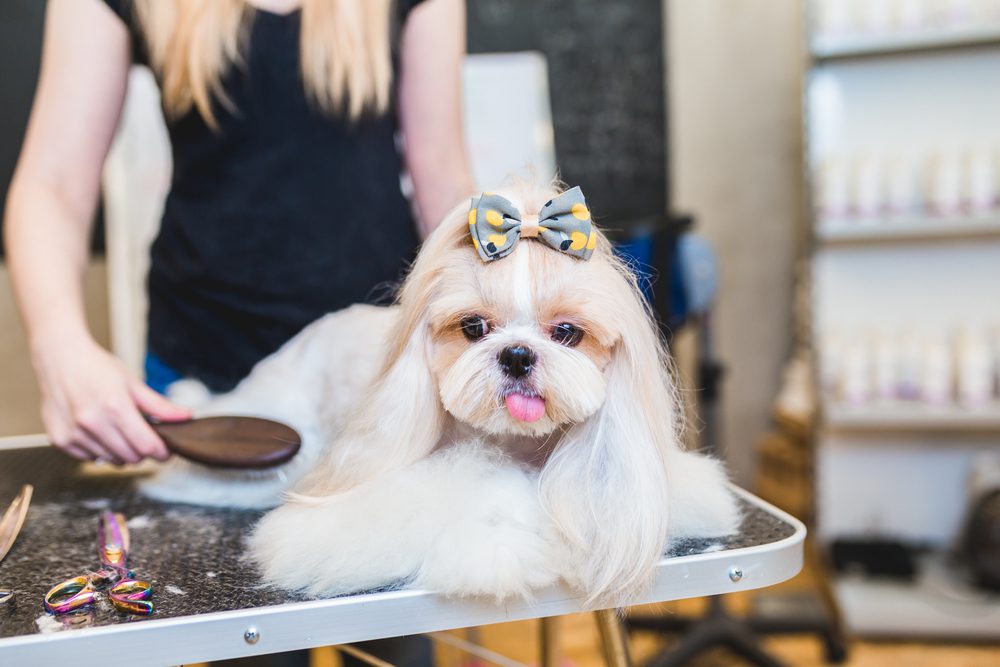
Brushing is the most important grooming job for a Shih Tzu. The American Shih Tzu Club recommends a good wire pin brush with flexible pins, used in layers from the feet up. The American Kennel Club advises brushing a long coat every day and making sure you reach the skin.
How to line brush a Shih Tzu
- Lightly mist the coat with a detangling spray. Brushing a dry coat can break the hair.
- Start at a lower leg. Hold the hair up with one hand so you can see a thin line of skin.
- Brush the hair below the line down and away from the skin.
- Let down a new thin layer and repeat. Work up the leg, then along the body, chest, and tail.
- Finish by running a steel comb through the coat. If the comb catches, you found a tangle the brush missed.
Pay extra attention behind the ears, under the legs, and on the belly. Mats form fastest where hair rubs. The coat often changes and mats more easily around 10 to 12 months of age, so brush more often during that time.
Never cut out a mat with pointed scissors. The skin under a mat can get pulled up into it and is easy to cut. Work small tangles apart with your fingers and a comb. If your dog is badly matted, see a professional groomer, who may need to shave the coat short.
Tools for brushing
- Chris Christensen 27 mm Oval Pin Brush. A long-pin brush designed for long, silky coats, with stainless steel pins and a lightweight wooden body. Check price on Amazon →
- Chris Christensen Greyhound-Style Buttercomb. A 7.5-inch steel comb with fine and coarse teeth, useful for checking the coat after brushing and for the face. Check price on Amazon →
- TropiClean Detangler Spray. A leave-in conditioning spray that helps the brush glide through tangles. Check price on Amazon →
For a deeper look at coat types and shedding, read our Shih Tzu coat care guide.
Step 2: Bathing and Drying
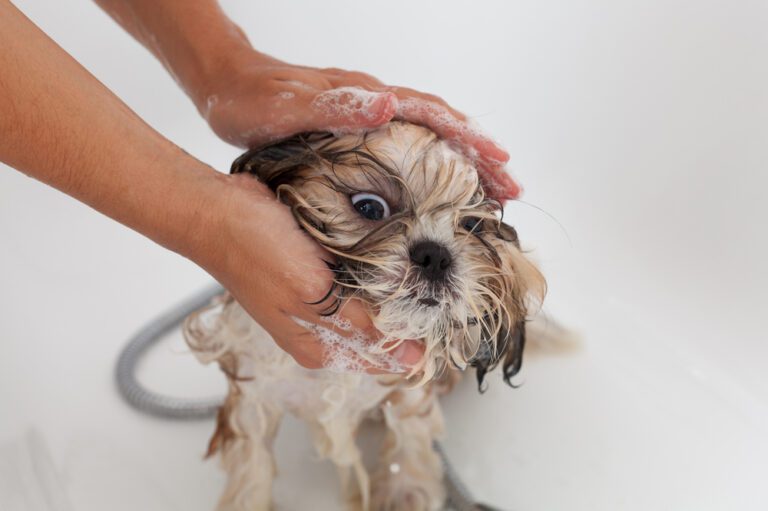
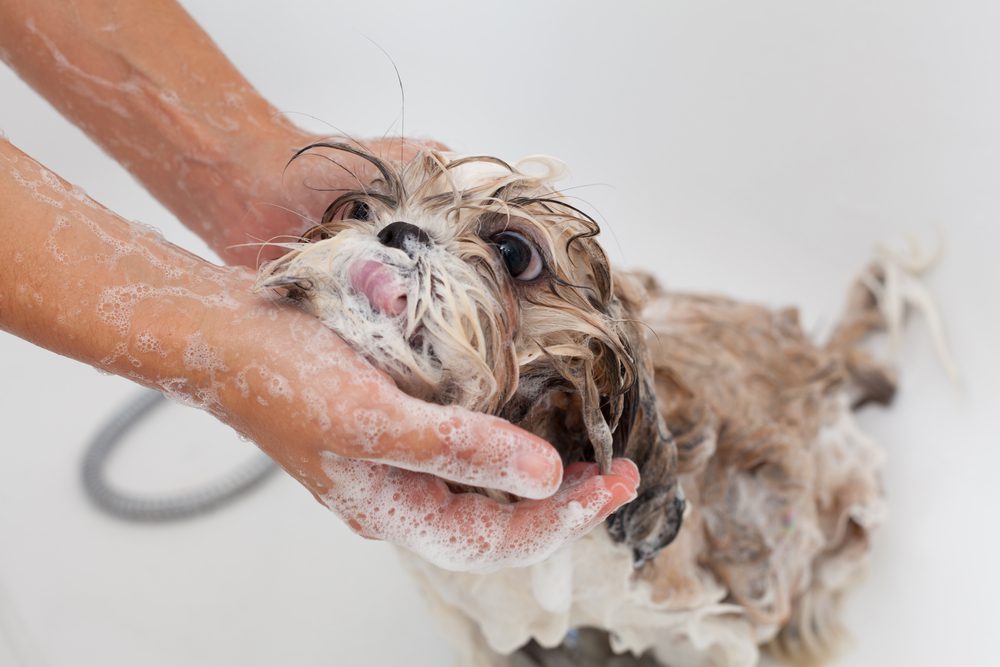
The American Shih Tzu Club and the American Kennel Club both suggest a bath about every three to four weeks for a pet Shih Tzu, or sooner if your dog gets dirty.
- Brush first. Water tightens tangles into hard mats, so always brush and comb out the coat before a bath.
- Use a dog shampoo. Human shampoo is made for different skin. See our guide to the best shampoo for Shih Tzus.
- Wet the coat fully with lukewarm water. Keep water out of the eyes and ears.
- Rinse very well. Leftover shampoo can itch.
- Towel dry, then blow dry on a low, cool setting while you brush. The American Shih Tzu Club recommends blow drying, because a long coat that stays damp can mat and smell.
Step 3: Face, Eyes, and Topknot
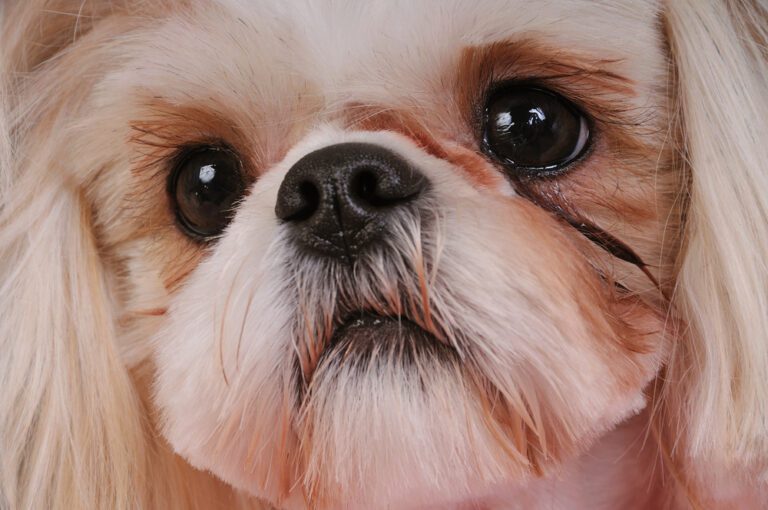
A Shih Tzu’s face needs care every day. The long hair can poke the eyes, hold food, and trap moisture that causes staining.
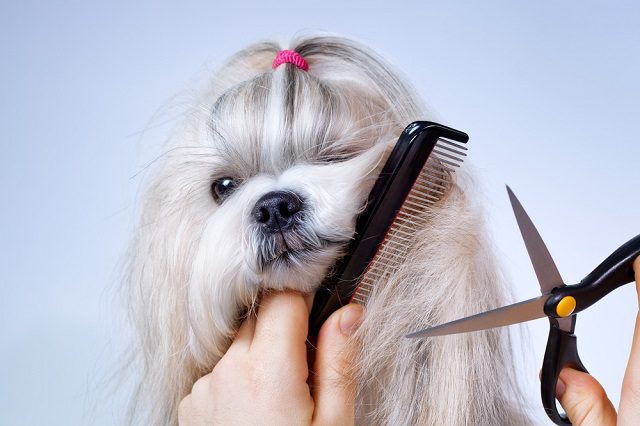
- Comb the mustache and topknot daily. A fine steel comb works well.
- Wipe the eye corners with a clean, damp cloth each day. Use a fresh part of the cloth for each eye.
- Tie up the topknot. The American Shih Tzu Club suggests securing the topknot with a small latex band once a puppy has enough hair, at around five months. This keeps hair out of the eyes. Never pull the band tight against the skin.
- Trim carefully. Use scissors with rounded safety tips. Keep the blades parallel to the face and point them away from the eyes. Place your fingers between the scissors and the skin.
Trimming the hair at the inner eye corners is also the most effective way to cut down on tear stains.
When to see a vet instead: red, cloudy, or squinting eyes, heavy discharge, or sudden tear staining can signal an eye problem. Shih Tzus have prominent eyes that injure easily. Read our Shih Tzu eye care guide.
Tools for the face
- GLADOG 5-in-1 Grooming Scissors Set. Includes straight, curved, and thinning shears with safety round tips, plus a comb. Round tips lower the risk of pokes near the eyes and feet. Check price on Amazon →
- PET SHOW Latex Grooming Bands. Small latex bands for tying up a topknot. Check price on Amazon →
Step 4: Paws and Paw Pad Hair
Hair grows between a Shih Tzu’s paw pads and can cover them completely. Long pad hair can make your dog slip on smooth floors. It also collects snow, ice balls, burrs, and dirt. The American Shih Tzu Club advises trimming this hair level with the pads.
- Have your dog lie on their side or sit in your lap in good light.
- Spread the pads gently with your fingers.
- Use a small, quiet trimmer to clear the hair level with the pads. Do not dig deep between the toes.
- Use round-tip scissors to tidy the hair around the edge of the foot into a neat, round shape.
- Check the pads for cuts, cracks, redness, or anything stuck between the toes.
Avoid pointed scissors between the pads. The skin there is thin and easy to cut. A small trimmer with a rounded blade is safer for most owners.
In winter, road salt and ice can irritate paws. In summer, hot pavement can burn them. A paw wax adds a thin protective layer. Wipe your dog’s feet after walks in either season. See our guide to Shih Tzus in hot and cold weather.
Tools for paws
- oneisall Low-Noise Paw Trimmer. A cordless mini trimmer with a narrow rounded blade and an LED light for seeing between the pads. A quiet motor can help nervous dogs. Check price on Amazon →
- Musher’s Secret Paw Wax. A wax-based paw balm used to protect pads from salt, snow, and hot or rough surfaces. Check price on Amazon →
Step 5: Nail Trimming
VCA Animal Hospitals says most dogs need a nail trim about once a month. Small dogs that walk mostly on grass or carpet, like many Shih Tzus, often do not wear their nails down. If you hear clicking on the floor, the nails are probably too long.
How to trim a Shih Tzu’s nails
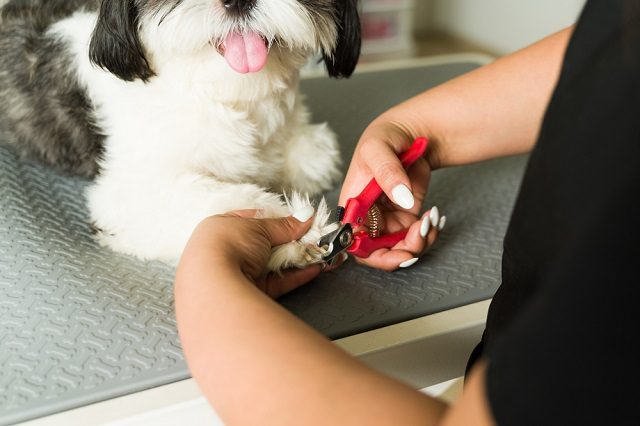
- Hold a paw gently and press the pad to extend the nail.
- Find the quick, the pink area with blood vessels and nerves. On light nails you can see it. On dark nails you cannot, so trim tiny slices at a time.
- Cut straight across the tip, just in front of the curve. Stop when you see a small dark circle in the center of the cut surface.
- Do not forget the dewclaws on the inside of the legs. The American Shih Tzu Club notes they do not wear down naturally.
- Reward your dog with a treat after each paw.
Trimming right after a bath can be easier, because the nails are softer.
If you cut the quick: stay calm. Press styptic powder onto the nail tip for about 30 seconds. Plain cornstarch can help in a pinch. Call your vet if the bleeding does not stop after 5 to 10 minutes of pressure.
Clippers or grinder?
- Clippers are fast and quiet. A small size with a safety guard suits a Shih Tzu’s tiny nails.
- Grinders file the nail down slowly and leave a smooth edge. They are a good choice for dogs that fear the snap of clippers. Keep long hair away from the spinning head, and introduce the sound slowly.
Tools for nails
- gonicc Nail Clippers for Small and Medium Dogs. Stainless steel blades with a safety stop to help prevent cutting too far. Check price on Amazon →
- Casfuy 2-Speed Nail Grinder. A quiet grinder with low and high speeds. Start on low for small nails. Check price on Amazon →
- Miracle Care Kwik Stop Styptic Powder. Keep it on hand whenever you trim. Check price on Amazon →
Step 6: Teeth
Dental disease is one of the most common health problems in Shih Tzus. A 2024 Royal Veterinary College study of more than 11,000 Shih Tzus found periodontal (gum) disease was the most common specific disorder, affecting 9.5 percent of the dogs. Small breeds have crowded teeth that trap plaque.
- Brush your dog’s teeth daily if you can. Even a few times a week helps.
- Use a toothpaste made for dogs. Never use human toothpaste. Some contain xylitol, which is poisonous to dogs.
- Look for the Veterinary Oral Health Council (VOHC) seal. It means a product met set standards for reducing plaque or tartar.
- See your vet for dental checkups. Brushing does not remove tartar that has already hardened.
Tools for teeth
- Petsmile Professional Pet Toothpaste. A toothpaste for dogs and cats that appears on the VOHC list of accepted products. Check price on Amazon →
- Soft-Bristle Pet Toothbrush. A small, soft brush that fits a Shih Tzu’s mouth. Check price on Amazon →
What About the Ears?
Shih Tzus grow hair inside their ear canals. Many groomers used to pluck it out routinely. Veterinary dermatology experts now advise against routine plucking in healthy ears, because it can cause irritation and inflammation. Trim hair that sticks out, keep the ears dry, and ask your vet before removing hair from inside the canal. Learn more in our guides to cleaning Shih Tzu ears and Shih Tzu ear hair removal.
Home Grooming or a Professional Groomer?
Many owners do daily care at home and book a professional for full haircuts. The American Kennel Club notes that a shorter puppy cut is easier to manage but needs a professional trim every four to six weeks. For style ideas, see our Shih Tzu haircut guide.
Book a professional groomer if your dog is heavily matted, will not hold still for scissors, or needs a full body clip. If your Shih Tzu smells even after a bath, read why Shih Tzus can smell bad, as odor can signal a skin, ear, or dental problem.
Frequently Asked Questions
How often should a Shih Tzu be groomed?
Brush a long coat daily, bathe about every 3 to 4 weeks, and trim nails about once a month. Dogs in a short puppy cut usually need a professional trim every 4 to 6 weeks.
What is the best brush for a Shih Tzu?
A pin brush with long, flexible pins works well for a long coat, followed by a steel comb to find hidden tangles. Dogs in a short cut may do well with a slicker brush.
Can I groom my Shih Tzu at home?
Yes. Most daily care, including brushing, face cleaning, paw trims, nails, and teeth, can be done at home with the right tools. Book a professional for full haircuts or heavy mats.
How do I trim around my Shih Tzu’s eyes safely?
Comb the hair forward first, use round-tip scissors, keep the blades parallel to the face and pointed away from the eyes, and keep your fingers between the blade and the skin.
What if I cut my Shih Tzu’s nail too short?
Press styptic powder or cornstarch onto the nail tip for about 30 seconds. Call your vet if bleeding does not stop after several minutes.
Sources
- American Shih Tzu Club. Grooming the Companion Dog.
- American Kennel Club. The Glamorous Shih Tzu Coat, From Top Knot to Tail. Updated 2026.
- VCA Animal Hospitals. How to Trim a Dog’s Nails.
- VCA Animal Hospitals. Handling Exercises for Trimming Nails and Brushing Teeth.
- Veterinary Oral Health Council. VOHC Accepted Products.
- Dale F, Brodbelt DC, West G, Church DB, Lee YH, O’Neill DG. Demography, common disorders and mortality of Shih Tzu dogs under primary veterinary care in the UK. Canine Medicine and Genetics, 2024;11:2.
- VetVine. Plucking Hair From Dog Ears.
This article is for general information. It is not a substitute for advice from your veterinarian. Read our medical disclaimer.